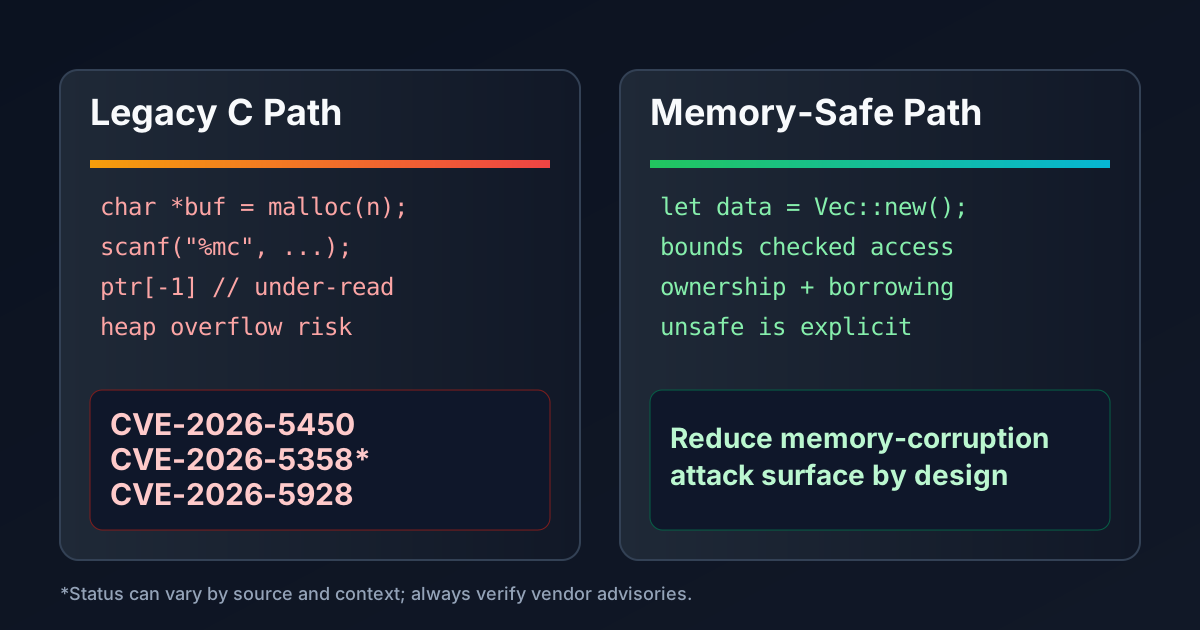
When multiple glibc CVE identifiers appear in a short window, discussion usually swings between panic and denial. Neither helps. The useful path is to separate what is confirmed, what is disputed, and what should change in engineering decisions.
This article focuses on the three identifiers you asked for: CVE-2026-5450, CVE-2026-5358, and CVE-2026-5928, then answers the practical question: why Rust is relevant in this specific context.
Quick technical recap
1) CVE-2026-5450 (glibc, scanf family)
Public records and vendor summaries describe a heap overflow scenario tied to scanf family behavior (%mc) under specific large width conditions. This is a classic memory corruption class where impact ranges from DoS to more severe outcomes depending on process context.
Why it matters: this is not an exotic one-off; it is a recurring category in C ecosystems.
2) CVE-2026-5358 (glibc / NIS+ context)
This one requires nuance: sources are inconsistent, and some databases mark it as rejected, with rationale around trust-boundary assumptions and Linux distribution relevance for that legacy path.
So the identifier exists in circulation, but production risk depends on whether the affected legacy path is actually used and how your distro/vendor classifies and backports it.
Why it matters: an identifier alone is not enough; status and reachable attack surface are what decide priority.
3) CVE-2026-5928 (glibc, ungetwc)
This issue is tied to wide-character handling (ungetwc) and incorrect buffer-pointer behavior, with outcomes including under-read information exposure or process crashes.
Why it matters: even “just a crash” is still an incident if the target service is critical.
Shared root pattern
Despite severity/status differences, all three point to the same structural theme:
- manual memory management
- pointer-sensitive edge cases
- security debt from legacy compatibility layers
That is why memory-safety strategy is now an operations topic, not just a language-war argument.
Why Rust is useful in this case
Rust is not a magic shield, but for the bug classes we are seeing here, it gives concrete risk reduction:
- Ownership and borrowing prevent large classes of use-after-free/double-free in safe code.
- Bounds-checked access patterns reduce out-of-bounds reads/writes.
- Explicit error handling (
Result) reduces silent edge-case failures. unsafeis explicit and auditable, making high-risk areas reviewable by design.
In practice: Rust does not eliminate bugs, but it reduces the most expensive bug categories.
Where Rust helps now, and where it does not
Immediate wins
- new network services
- parsers and untrusted input pipelines
- security-sensitive agents and CLI tooling
- components directly exposed to user or external data
Not automatically solved
- weak trust models and poor architecture
- supply-chain risk in dependencies
- bad policy/configuration hygiene
- defects inside
unsafeblocks and FFI boundaries
Practical migration strategy
A realistic strategy is not “rewrite everything now,” but:
- map components by blast radius
- migrate input-facing/parser layers first
- keep stable legacy behind strict interfaces
- enforce CI security gates (
cargo audit, SAST, fuzzing)
That gives measurable security gain without stalling delivery.
Conclusion
CVE-2026-5450, 5358, and 5928 are more than three identifiers. They are a signal that memory safety is still an operational reliability issue.
For production systems, the question is no longer “will another similar bug appear?” but “how resilient is our stack when it does?”
In that context, Rust is not hype. It is a disciplined way to reduce risk surface where incident cost is highest.
Sources
- NVD: CVE-2026-5450
- NVD: CVE-2026-5928
- NVD / status discussion: CVE-2026-5358
- SUSE CVE record: CVE-2026-5928
- Debian security tracker: CVE-2026-5450
- RustSec (reminder that Rust ecosystems also require auditing): RUSTSEC-2026-0103
Related articles
Need help with this topic?
ANIM offers free assessments for small and medium businesses. Get in touch and let's discuss your needs.
Free assessment