AI automation4 min read
New AI models and agents - a week in review (October 2026)
What Google, Meta, OpenAI, Anthropic, Alibaba and other frontier labs shipped in the last seven days - and what it means for small-business automation.
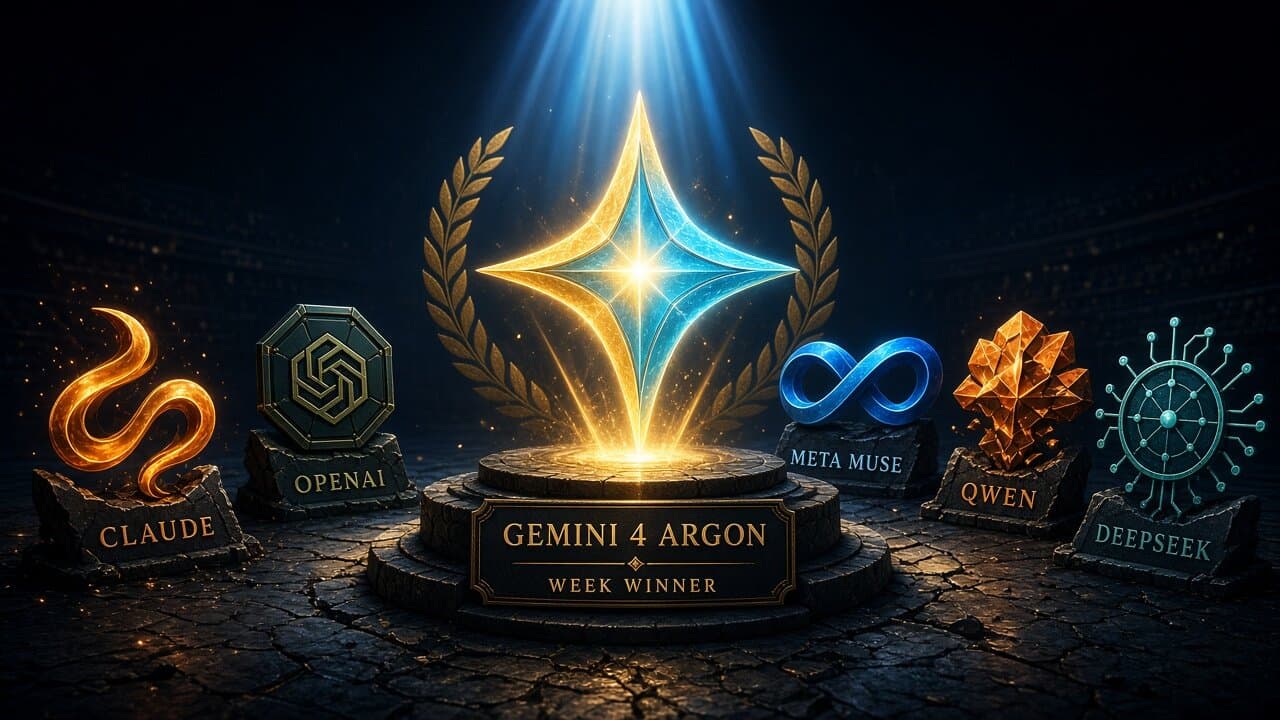
From 10 to 17 October 2026, frontier labs did not only ship “a bigger model”. The story of the week is long-horizon agents, computer use, and cost per finished task. Below is a comparison of what actually landed in that window, with links to primary sources.
At a glance
| Lab | What shipped (10-17 Oct) | Focus | Where to start |
|---|---|---|---|
| Gemini 4 Argon | Frontier reasoning, coding, cyber, 1M tokens | API / Gemini app (Pro, Ultra) | |
| Meta | Muse Wonder + Muse Spark Open | Agents + open weights | Muse Code / API / Hugging Face |
| Anthropic | Code Review GA | Software agents in production | Claude Code / Claude |
| OpenAI | Ultrafast + Agents API (computer use), Live/voice | Speed and managed agents | Responses / Agents API |
| Alibaba | QwenGyre, Qwen3.x Max / AgentWorld | Long coding agents, training | Bailian / Qoder CLI |
| DeepSeek | V4.1-Flash-1017 | Speed and cost on agent benches | Web / app / API |
| xAI | Grok Voice 3.0 | Speech-to-speech | Speech API |
| Mistral | Timestral | Time series (not chat) | Model Studio |
Google - Gemini 4 Argon
On 13 October, DeepMind released Gemini 4 Argon: a flagship for hard, multi-step work (engineering, finance, legal, cyber). The unified window is 1,048,576 tokens; introductory API pricing is $2 / 1M input and $10 / 1M output until 30 November 2026, then $4 / $20 (Google Cloud).
For businesses: Argon targets long agents (code migrations, documents, defence), not snappy chat. If you need “one model that stays on task for hours”, this is the week’s reference point.
Meta - Muse Wonder and open-weight Spark
On 12 October, Meta launched Muse Wonder (API + Muse Code, $4 / $20 per million tokens) and Muse Wonder Full (Muse Code subscription only) - its first Muse-line frontier models for agents and coding (Meta Dev).
On 15 October came Muse Spark Open: an open-weight multimodal model (816B total, ~42B active, 1M context) for local and self-hosted agents. That is a different offer from closed flagships: the weights and memory are yours; the cost is hardware.
Anthropic - agents in the software process
There was no new Opus/Sonnet flagship this week. Instead, on 15 October Claude Code Review went generally available: an agent that catches bugs before production. For engineering teams that is more concrete than another leaderboard - it sits in the CI/review loop.
(Haiku 5.5 and Sonnet 5.5 from earlier days remain the cheap/mid tier for subagents; this week’s product focus was Code Review.)
OpenAI - speed and managed agents
DevDay (September) is behind us; this week’s changelog and products build on it:
- GPT-6.1 Sol Ultrafast in the Responses API (lower inter-token latency) - API changelog.
- Agents API with computer use: the agent works in a hosted browser, with access approvals.
- GPT-Live updates (Decisions, prompt-to-voice) - voice and decisions inside a session.
For small teams: OpenAI still sells “agent as a service” most clearly (sessions, sandboxes, MCP), not only a raw model.
Alibaba - long horizons and agent training
Alibaba’s Qwen line moved on two fronts this week:
- QwenGyre (12 Oct) - an RL framework for multi-hour agent rollouts; on Qwen 3.8 2.4T they report training speedups and +6 pp on NL2RepoBench.
- Qwen3.x Max / Qoder CLI - flagships for coding agents with long autonomous runs (Bailian, Qoder CLI test).
If you care about an open ecosystem and agent harness, Qwen remains the strongest Chinese alternative alongside DeepSeek.
Other frontier moves this week
- DeepSeek V4.1-Flash-1017 (17 Oct): a faster flash snapshot with better agent/coding scores at the same price - useful when you need volume, not maximum depth.
- xAI Grok Voice 3.0 (14 Oct): speech-to-speech with reasoning on by default; replaces Voice 2.0 in the API.
- Mistral Timestral (15 Oct): a first family for time series (5M-209M), not chat - a different niche from a general agent.
What to pick for small-business automation
You do not need everything. Choose by job:
- One long engineering or document task - Argon or Wonder Full / Astra-class, with a human at the end.
- Many short steps (routing, summaries, subagents) - cheap flash / Haiku / Luna-class models; price per million tokens is the decision.
- An agent that clicks UI or holds a session - OpenAI Agents API (computer use) or Claude/Codex harnesses; not “chat only”.
- Your own server / EU data control - Muse Spark Open or Qwen/DeepSeek self-host, with a GDPR processor agreement.
- Voice or forecasting - Grok Voice 3.0 or Timestral; neither replaces GPT/Claude in the inbox.
A good agent is not the one with the highest bench score. It is the one that finishes your process cheaper than a person - and leaves a person on the decision that goes to the customer.
If you want one process (enquiries, invoices, support) wired to a concrete model and harness, get in touch - we start from one measured flow, not a model catalogue.